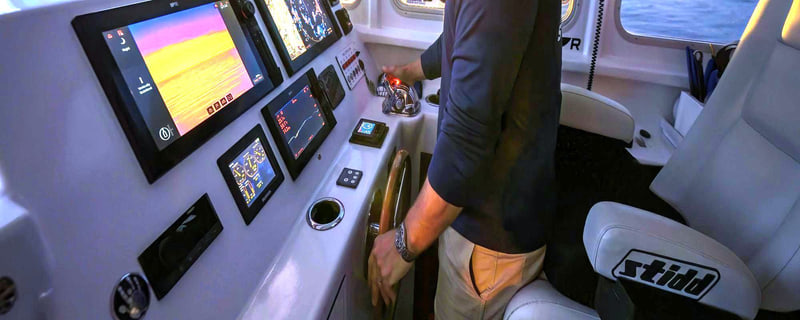
Element
Element chartplotter-fishfinders operated with keys. Two lines, three sizes each.
Choose your Element.
Element chartplotter-fishfinders operated with keys. Two lines, three sizes each.
-
Element S
Key-operated chartplotter with built-in High CHIRP single-channel sonar; the simpler, lower-cost Element.
Element S is a chartplotter with a single-channel High CHIRP sonar inside, operated with physical keys: an oversized waypoint key and three user-programmable quick keys. It runs LightHouse Sport on a quad-core processor and shows depth and bottom contour rather than a picture of what is beneath the boat. Displays are 1500 nits; the 7″ and 9″ are 800 x 480 on a TN panel and the 12″ is 1280 x 800 on an IPS panel.
It connects to NMEA 2000, has Wi-Fi, a microSDXC slot and a 15-pin transducer connector, and works with the CPT-S series High CHIRP transducers (transom, through-hull and in-hull). It takes LightHouse, Navionics and C-MAP charts and supports RealBathy sonar mapping. A good fit for a cruising, sailing or small powerboat where the screen is first a chartplotter.
-
Element HV
Element with HyperVision sonar: 1.2 MHz imaging plus DownVision, SideVision, RealVision 3D and conical CHIRP.
Element HV has the same key-operated body, quad-core processor and 1500-nit screens as Element S, with a far more capable sonar. HyperVision runs at 1.2 MHz for very fine detail at short range, about 38 m, in RealVision 3D, SideVision and DownVision views. Standard imaging at 350 kHz reaches about 91 m for SideVision and 3D and 183 m for DownVision, and a 200 kHz conical high CHIRP channel reaches about 274 m.
It uses a 15-pin HyperVision transducer connector and the HV-100 all-in-one transducer is the match. Sizes are 7″, 9″ and 12″, with the same display panels as Element S. Choose it for someone fishing shallow or inshore water who wants to see structure and fish, not just a depth line.
Element is the simpler helm: one screen, quick keys, and sonar built in rather than networked.
One networked system
Radar, sonar, autopilot, instruments and cameras all display on the same LightHouse screen. We set the network up on the bench before installation.
Pair it with radar